2-SHOT INJECTION MOLDING COMPANY

As a world-class NPD team, you are tasked with creating an award-winning design, consolidating parts to simplify manufacturing and assembly, reducing costs and ensuring the highest quality of the components and the assembly. Those objectives seem like they conflict with each other… but they DON’T, with 2-shot injection molding.
What is 2K or 2 Shot Injection Molding?
Multi-Material Molding is known by many names in the industry and around the world. 2-Shot Molding, 2K Molding, Multi-Shot Molding and Multi-Material Molding. All refer to the process of using one injection molding machine to make a part from more than one plastic material.
The reason someone would want to do this is simply to lower the cost of a product and/or achieve some kind of performance that a single shot molded part cannot achieve. For example, it is generally less expensive to mold one part in a 2-shot press than it is to mold two parts individually in separate single shot presses and then assemble the two parts together.
Also, think of a cap that must seal off against a hard surface. The cap needs to be made of a stiff material in order to hold its shape, but the seal needs to be made of a softer more compliant material to achieve an airtight or water-tight seal. Using traditional manufacturing methods, the cap might be molded of ABS and the seal might be molded of TPE using another process. The two separate parts would then be assembled to make the final product.
With 2-shot molding, the final product would be made in one machine and since the seal would be molded over the cap in the second shot, there would be no assembly required. In this way, this application achieves both goals; a cost reduction for manufacturing the part in one machine and a part performance that could not be achieved as an assembled part, (in terms of a seal with a higher efficacy that cannot be disassembled or misassembled).
Two-shot tooling is more expensive than traditional tooling and a two shot injection molding machine has a higher press rate (cost) than a single shot machine, so the economics are favorable in higher volume/demand scenarios.
Since every case is different with regard to the problem being solved, it’s valuable to analyze the two manufacturing scenarios fully to get a clear picture of the ROI.
Advantages of Two Shot Molding
The 6 advantages of 2-shot molding fall into two basic categories:
1. Cost
- Molding 2 different parts in one process cycle. Taking the simplest example of a 2-shot part, a part that needs to seal off against something. It is most of the time less costly to run a 2-shot mold in a larger molding press than it is to run two smaller single shot molding presses making 2 separate parts.
- Labor savings by eliminating an assembly operation. Using the same example as above, leveraging the 2-shot process means the parts are fused together or molded together into one part, thereby eliminating the assembly operation.
- Convert a metal part to plastic. Metals are categorically more expensive than plastic resins and with glass fillers, plastics can be made to perform better. When converting a part from metal to plastic, generally, the same performance criteria can be achieved within the same size envelope as the metal part. The resulting design is not only lighter in weight but generally less expensive from a material cost point of view.
2. Performance
Ability to achieve a component design that would otherwise be impossible to achieve. Let’s take a cosmetic jar for example. The jar is mostly decorative with some functionality (holding cosmetics). But the decorative design includes some unusually thick areas, (say the outside of the jar is oval shaped but the inside of the jar is round). To make this out of glass is a challenge but doable and expensive. To make the jar out of clear plastic (to replace the glass), it would be tempting to mold the part from a single shot of acrylic.
However, due to the uneven wall sections, the thick end of the jar would have imperfections in it called sink marks. It is a defect caused by the solidification of melted plastic and is common when thick sections of a part design are filled with plastic. The remedy is to mold the part using the 2-shot process. The first shot molds the inner (round) jar, the part cools and then a second shot of the same material is molded over it, creating the thick sections but eliminating the sink because the first shot has already cooled.
- Benefit from two different materials to achieve two different aspects of the design (for example, stiffness and compliance as in a seal application)
- Higher yield due to it being impossible to mis-assemble parts, higher performance due to the two materials being chemically fused together. It’s possible but maybe not desirable to mold two materials that are not compatible with each other. That only means that the two materials won’t chemically bond with each other. Is that bad? It depends on the application. Maybe the material properties of the two shots are such that they will not chemically bond, in which case, a mechanical feature in the design could trap the second shot and keep it from coming loose.
Why Choose CJT?
CJT Industry, Inc. has performed multi-material molding services for many companies, helping them achieve designs that guarantee the integrity of their products. Even the most complicated product designs can be delivered on-time and on-budget, leveraging the power of CJT’s Multi-shot process, which helps you reduce cost, improve performance, and create unique products you’ll be proud to launch.
What to Look for in a 2K Molding Company
What to look for in a 2K Molder is the same for any type of molding:
- Are they organized on the manufacturing floor? (is there a logical path from pellets to parts that ensures good quality and reliable deliveries?)
- Is the place clean?
- Do they know what they are doing? (Do they give me thoughtful and complete answers to my questions).
- Are the machines and injection units sized properly for the parts they are making? It’s tempting to try to fit a job in the wrong sized press because it’s “available” but that is a recipe for poor quality product.
CJ Technology 2K Molding Capabilities
CJT Industry, Inc. partners with you to offer expanded production capabilities through our innovative multi-material molding services. We have 200,000 sq. ft. of factory space in Thailand and 1,000,000 sq. ft. in China.
Outside of being a 2-Shot injection molding company and offering services as such, we can also mold dissimilar materials like ABS+TPE (hard and soft plastic), ABS+PA (two hard but different plastics) and ABS+ABS (two similar plastics).
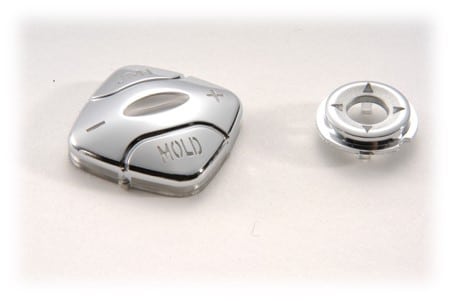
2-Shot Molding + Electroplating
How can the 2-shot molding process and electroplating combine to create a part that would be unachievable any other way?
1. Metal to Plastic Conversion
When a decorative metal part is being replaced by plastic, it’s not enough to just make it “look” like metal, it has to “perform” like metal too. Consider a handle end cap for a kitchen range. There are agency requirements for the strength of the handle as well as the flammability of the materials used for the handle. To achieve the strength aspect, a glass fiber filled resin (nylon) would be a good choice for both strength and flammability, but in addition to many nylons not being palatable, the glass fiber content of the resin creates a very rough surface. If an ABS or palatable nylon is molded over the glass filled nylon, now the designer has a part that can meet the strength and flammability requirements and also be plated to look like polished metal!
2. Soft Touch over Metal
In many consumer products (think razor handles and measuring tape cases), a common design direction is to include soft rubberized design features over the metallized surface. But doing this in a metal design requires molding the rubber and diecasting the metal separately, then assembling them together. If 2-shot molding were employed, the body of the product would be molded of a palatable grade resin in the first shot and a soft touch elastomer in the second shot. When going through the electroplating operation, the palatable grade of resin gets the shiny metal finish on it, but the soft touch elastomer remains unplated. That is because the elastomer is not affected by the plating chemistry. What is left is a shiny metal tape case or razor handle with colored soft-touch highlights over the top.
2-Shot Injection Molding Services
Don’t allow complexity to stop you. Instead, allow CJT Industry, Inc. to help you solve your design and manufacturing challenges, so you can deliver a high-quality product on time and on budget! For more information about our multi-material molding solutions or to request a phone consultation, contact the CJT Industry, Inc. team at (847) 306-9877.